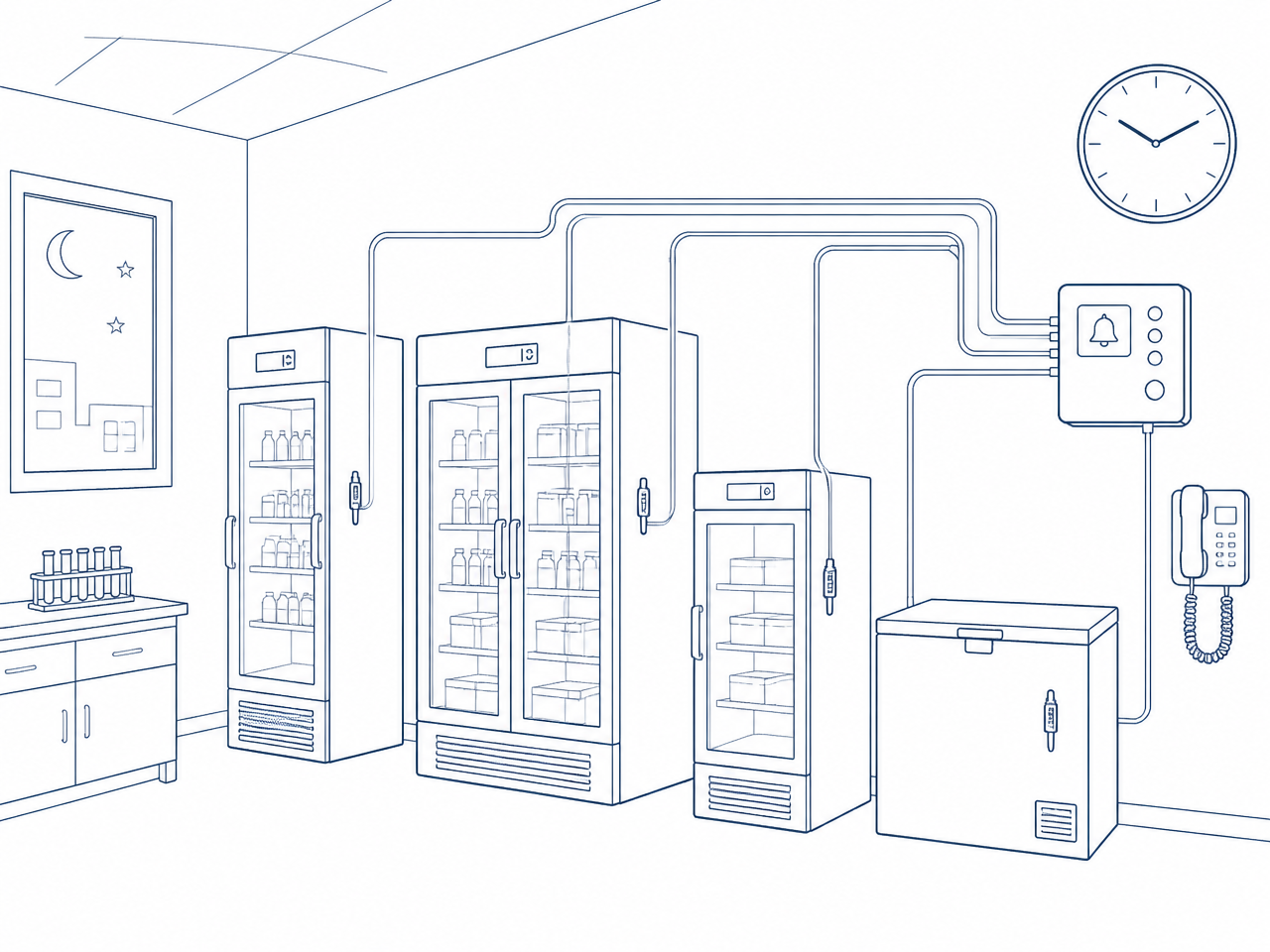
Why operational monitoring matters in a healthcare laboratory
Because the samples, cells and reagents a healthcare laboratory holds are irreplaceable, and the equipment protecting them fails silently. Continuous monitoring turns a slow, invisible drift into a documented alarm that reaches a named person in time to act, and leaves the evidence trail that inspectors, accreditation bodies and patients expect.
What is actually at stake
A hospital laboratory rarely loses money first. It loses a donor sample that cannot be taken again, a cell line that took two years to establish, a patient's embryos, a validated reagent batch, or a study whose data now has a hole in it. None of these can be bought back. The cost that follows is reputational and clinical, and it lands on people rather than on a balance sheet.
The second thing at stake is trust in the record. If a freezer spent nine hours at -50 °C and nobody can prove otherwise, every sample in it is suspect, including the ones that were fine. Without continuous measurement there is no way to separate the affected material from the rest, so a small excursion becomes a large discard.
Equipment fails quietly, not loudly
The failure modes that cause real damage are the ones nobody sees happen. A compressor degrades over weeks. A door gasket stops sealing. A CO₂ cylinder empties on a Friday evening. A pump keeps running while its output drifts. A building power event resets a controller to a default setpoint. In almost every case the device looks normal on the front panel.
- Slow drift: the value moves inside the alarm band for weeks, then crosses it at the worst moment.
- Out-of-hours failure: most excursions start after 17:00, and most damage happens because nobody was there.
- Local alarms nobody hears: a buzzer in an empty corridor is not an alarm, it is a noise.
- Manual checks: a twice-daily logbook reading misses everything that happens in between and cannot prove what it did not see.
- Single point of truth: a device that both controls and reports its own temperature will happily report the value it believes.
Independent measurement matters. A sensor that belongs to the monitoring system, not to the appliance, is what turns a controller fault into a detectable event.
Which parameters carry the risk
| Parameter | Where it matters | What failure looks like |
|---|---|---|
| Temperature | Freezers, ultra-low freezers, fridges, incubators, cryostorage, ovens | Sample degradation, invalid results, complete loss |
| CO₂ and O₂ | Cell culture, IVF and ART, hypoxia work | pH shift in the medium, culture loss, embryo damage |
| Humidity and differential pressure | Cleanrooms, isolators, airlocks, GMP suites | Contamination, loss of containment cascade |
| Liquid nitrogen level and room O₂ | Cryostorage rooms and biobanks | Sample thaw, plus a genuine asphyxiation risk to staff |
| Door status, air flow, power | Everywhere | The root cause behind most of the rows above |
What regulators and accreditation bodies expect
The frameworks differ by discipline, but they converge on the same three demands: know your critical parameters, measure them continuously with calibrated instruments, and be able to show the record afterwards along with what you did when something went wrong.
- ISO 15189 for medical laboratories: control of environmental conditions and documented corrective action.
- ISO/IEC 17025 for testing and calibration: measurement traceability and monitoring of conditions that affect results.
- EU GMP Annex 1 and Annex 11: continuous monitoring of classified areas, and computerised systems that keep an audit trail.
- 21 CFR Part 11: electronic records and signatures, meaning tamper-evident data and attributable actions.
- EU Tissues and Cells Directive and blood-bank regulation: storage conditions evidenced for the full retention period, which can run to decades.
An inspector rarely asks whether you had an alarm. They ask who received it, when, what was decided, and where that is written down.
How to judge whether your current setup is enough
- Can you prove, for any device and any date in the last five years, what the temperature was at 03:00?
- If an alarm fires at 02:00 on a Sunday, who picks up the phone, and what happens if they do not?
- Is the measurement independent of the device it is watching?
- Does the system keep measuring and alarming during a mains failure or a network outage?
- Is there a record of the response, not only of the deviation?
- Are sensors calibrated on a schedule, with certificates you can hand over?
If any answer is uncomfortable, the gap is usually not in the sensors. It is in the escalation path and in the evidence, which is exactly where an asset-level alarm system stops and an operational assurance system begins.
Asset assurance and process assurance are not the same thing
Asset assurance protects a device: this freezer must stay below -70 °C. Process assurance protects an outcome: this batch, this study, this treatment cycle must remain valid from intake to release. The second requires the first, plus context, plus a human chain that closes the loop when the alarm is not answered.
XiltriX exists at that second level. Monitoring is the input; the assurance is the escalation model, the staffed response and the record that follows. That is the difference between knowing something went wrong and being able to show it did not matter.