
Erasmus MC Central Biobank: millions of samples under one watch
Hundreds of scattered ultralow freezers became one central facility, and one monitoring picture across the whole campus.
- Construction started
- February 2020
- Samples stored
- 5.8M+ by end of 2023
- Sensors on campus
- Around 3,000
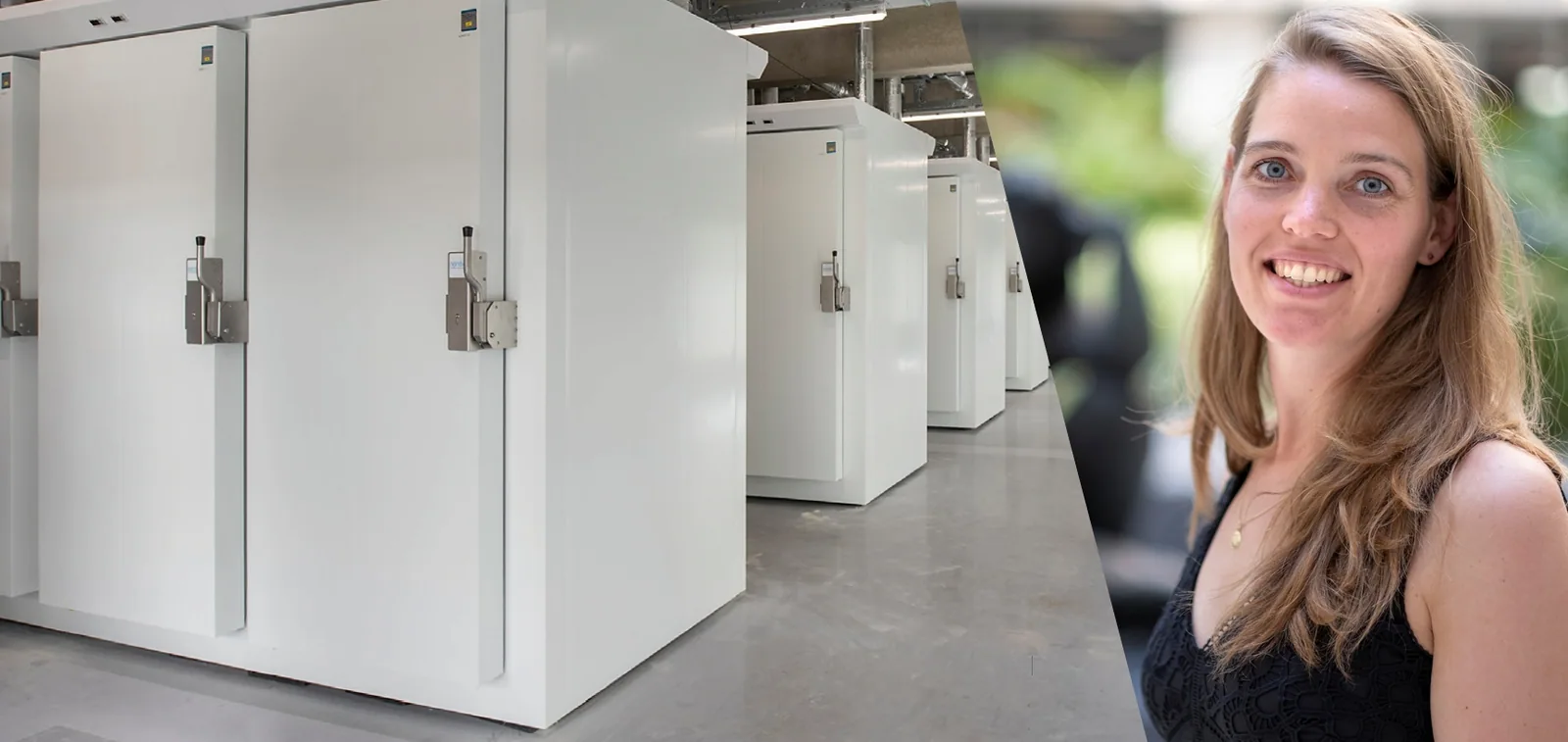
From hundreds of freezers to one facility
Construction of the central freezer facility started in February 2020. Hundreds of ultralow freezers spread across buildings and floors were consolidated into 56 Nordic freezers, each holding up to 164,640 samples.
Consolidation concentrates value. The same move that makes storage manageable also makes a single failure far more consequential. By the end of 2023 the facility held more than 5.8 million samples in over 77,000 storage boxes, and replacing conventional freezers with the Nordic concept saves close to a million euros per year.
The biobank runs as a managed service: departments and researchers entrust their samples to one central organisation, with sample tracking and tracing handled in an overarching biobank information management system.
Qualifying the watch before day one
Before the facility opened, a pilot installation was built together with the freezer supplier. Several design optimizations followed, resulting in a freezer fit for long-term biobank storage.
Operational and Performance Qualification studies, using independent XiltriX temperature sensors, established exactly how long a freezer holds under failure conditions and specific loads. The result: up to 24 hours of margin before the temperature inside the freezers reaches -60 °C, even after a major failure.
What the watch covers
Every freezer carries temperature and door sensors, and the cooling compressors are linked in as well, so the cause of a temperature change is visible alongside the change itself. Ambient conditions in the facility are monitored independently too.
The Nordic concept cools the cabinets from externally placed, redundant compressors, so cooling continues through maintenance and failures. Around 3,000 sensors are monitored across the Erasmus MC campus as a whole.
Who responds when something happens
Alarms follow the biobank's own escalation path until someone on the Erasmus MC side acknowledges them. A six-person functional management team on campus handles the technical and functional management of the monitoring system and picks up incidents early, as part of the facility's multi-tiered safety net.
The XiltriX 24/7 team is reachable for technical issues with the monitoring system itself, and is alerted if the monitoring chain falters. Responding to a storage alarm stays with the biobank's own people, who know the samples and the procedures.
Results and what is next
By the end of 2023: more than 5.8 million samples under management, close to a million euros saved per year, and up to 24 hours of margin before freezer temperatures reach -60 °C after a major failure.
Construction of the next expansion has started: a cryogenic facility with more than 50 large liquid nitrogen vessels for managed -196 °C storage, to be brought into the same monitoring picture. The biobank is also working towards ISO 20387 accreditation, with the process starting in 2024.
"With the temperature studies performed we have the peace of mind that even with big calamities we have up to 24 hours until the temperature inside our freezers reaches -60 °C."
这是简版内容。包含原始细节与数据的完整案例研究收录在资料库中。
阅读完整案例研究